The CapEx Trap: Why Standard Closet Doors Fail in Student Housing (and How Heavy-Duty Doors Protect ROI)
In student housing development and property management, small specification choices frequently create massive operational headaches. Among all architectural elements in a high-density student residence, few components suffer as much daily abuse — or generate as many work orders — as closet doors.
When developers value-engineer projects by specifying standard residential hollow-core bifolds, the initial savings are wiped out within the first two academic years. What seemed like a minor cost cut on the line item becomes a recurring operational drain — and in today's tightening student housing market, that drain is harder to absorb than ever.
The Market Backdrop: Why Margin Protection Matters Now
Recent data from Yardi Matrix underscores just how thin the margin for error has become for student housing owners and operators. As of July 2026, preleasing across the Yardi 200 universities reached an estimated 89.1 percent for the 2026-2027 academic year — a modest 100 basis points ahead of the prior year, but performance varied sharply by market. While 117 markets kept pace with or beat last year's leasing figures, 35 markets sat at least 10 percentage points behind, and 35 remained below 80 percent preleased.
Meanwhile, advertised rents across the Yardi 200 have held flat at roughly $930 per bed for six consecutive months, with annual rent growth of just 2 percent — a fraction of the 5.9 percent growth seen in the 2023-2024 leasing season. New supply is increasingly concentrated in the largest markets, and schools like Arizona State, Purdue, and North Carolina State are seeing preleasing lag by 8 to 16 percentage points as construction pipelines swell and international enrollment softens.
The takeaway for developers and asset managers: rent growth is no longer bailing out inefficient operations. In a market where every basis point of NOI is under scrutiny, unnecessary CapEx and OpEx bleed from a component as small as a closet door can no longer be written off as a rounding error.
1. The High Cost of "Low-Cost" Hollow-Core Doors
Standard residential bifold doors are engineered for light family use — not for the rigorous environment of Purpose-Built Student Accommodation.
Standard Hollow-Core Failure Points:
Thin hardboard skins ──> Punctures & impact cracks
Plastic track guides ──> Snap under force, causing derailment
Single-point pivots ──> Sagging and misaligned panels
Bottom floor tracks ──> Debris traps, bent channels & trip hazards
In a typical student housing turnover cycle, maintenance crews spend dozens of hours repairing off-track doors, replacing split-pin pivots, or patching punctured door faces — labor costs that compound in a rate environment where rent growth alone won't cover rising operating expenses.
Life-Cycle Cost Comparison (5-Year Horizon)
Feature / Metric Standard Residential Bifold Magiglide® Commercial Bifold
Core Material Hollow honeycomb / thin hardboard 45 lb solid particleboard core
Hinge System Top/bottom plastic pivots Continuous full-length piano hinge
Floor Track Requirement Yes (prone to bending/clogging) Floorless Track design (heavy-duty floor pivot)
HUD Compliance Fails commercial standards Exceeds HUD Heavy-Duty specifications
Average Replacement Cycle 2–4 years 65+ years
2. Why HUD Heavy-Duty Compliance Matters for Developers
HUD (U.S. Department of Housing and Urban Development) Heavy-Duty standards were created specifically to solve high-frequency wear and abuse issues in public and multi-family housing.
For developers and asset managers, specifying a door that meets or exceeds HUD Heavy-Duty standards ensures:
Structural Integrity: Heavy-density particleboard cores absorb impact without cracking or punching through.
Continuous Load Support: Full-length structural piano hinges distribute door weight evenly down the entire vertical height, preventing sagging over time.
Derailment Prevention: By eliminating cheap top sliders and flimsy pivot points, heavy-duty hardware keeps panels aligned even under aggressive usage.
In markets where preleasing is trailing — such as the 35 Yardi 200 markets currently running more than 10 points behind last year — every dollar saved on avoidable maintenance is a dollar that can go toward the resident experience improvements that actually move leasing velocity.
3. Eliminating Floor Tracks: Lower Maintenance & Built-In Accessibility
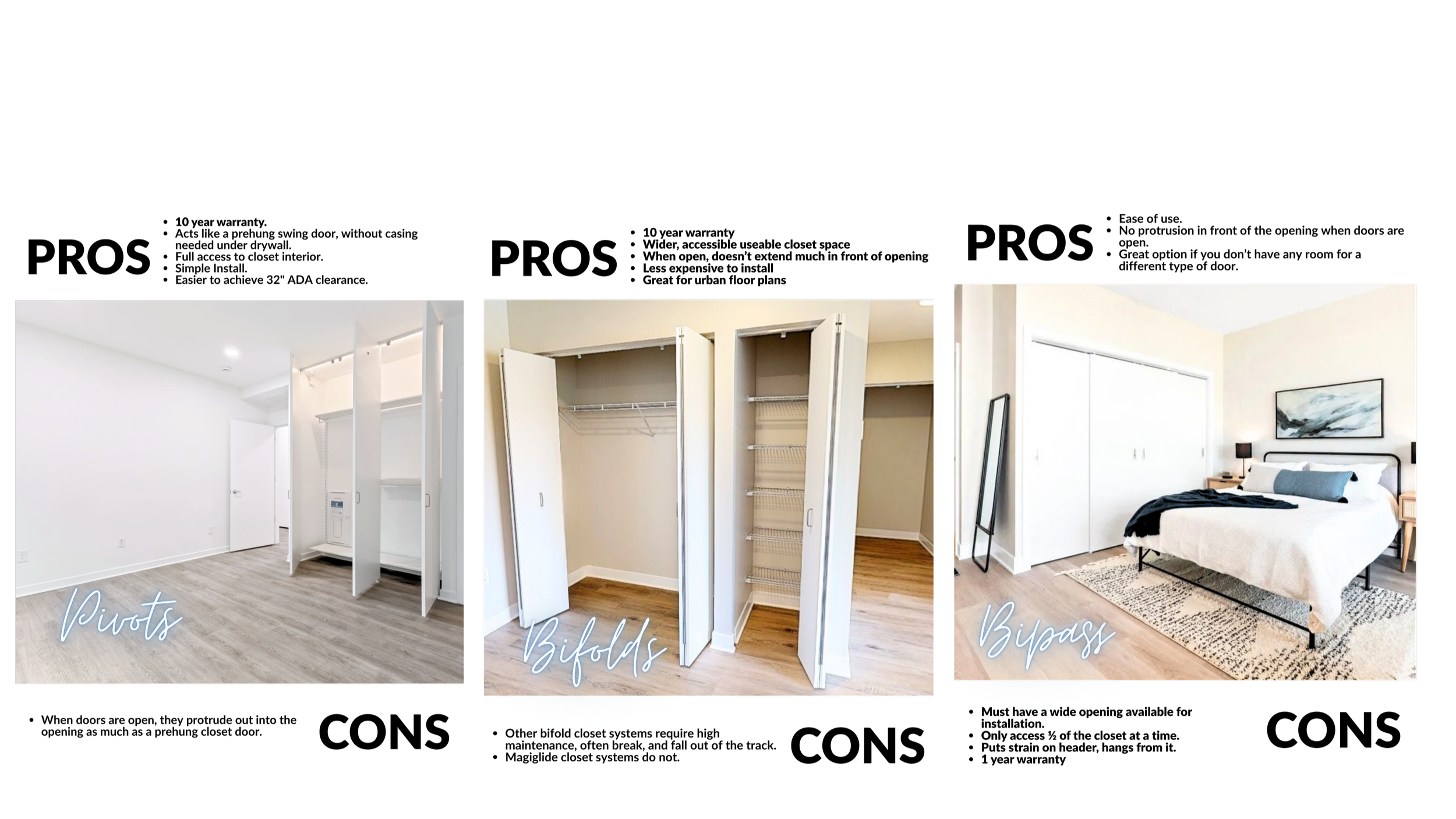
One of the largest failure points in traditional bifold doors is the bottom floor track. Over time, floor channels gather dirt, deform under foot traffic, and derail door rollers.
The Magiglide® commercial bifold doors trackless floor design eliminates the bottom channel completely. Instead, structural weight is supported via a heavy-duty floor pivot mounted outside the opening.
This design delivers two major operational advantages:
Zero Floor Maintenance: No bent tracks, no derailed pins, and zero debris accumulation.
Seamless ADA Compliance: Removing floor obstructions creates a smooth, continuous threshold ideal for accessible unit designs and easy flooring transitions during unit turns. To meet ADA requirements, make sure to design for the 32” clear.
4. Faster Unit Turns & Custom Sizing Efficiency
Turnover season in student housing is a high-pressure race to prepare hundreds of beds in a few short weeks — and with preleasing still climbing toward that 89.1 percent national average deep into the summer, owners can't afford turnover delays that push leasing timelines further behind.
Standard doors require custom trimming, shimming, and alignment on-site, wasting valuable trade labor. Landquist & Son manufactures Magiglide® doors custom-sized to the nearest 1/4" in width and in height, delivered ready-to-install:
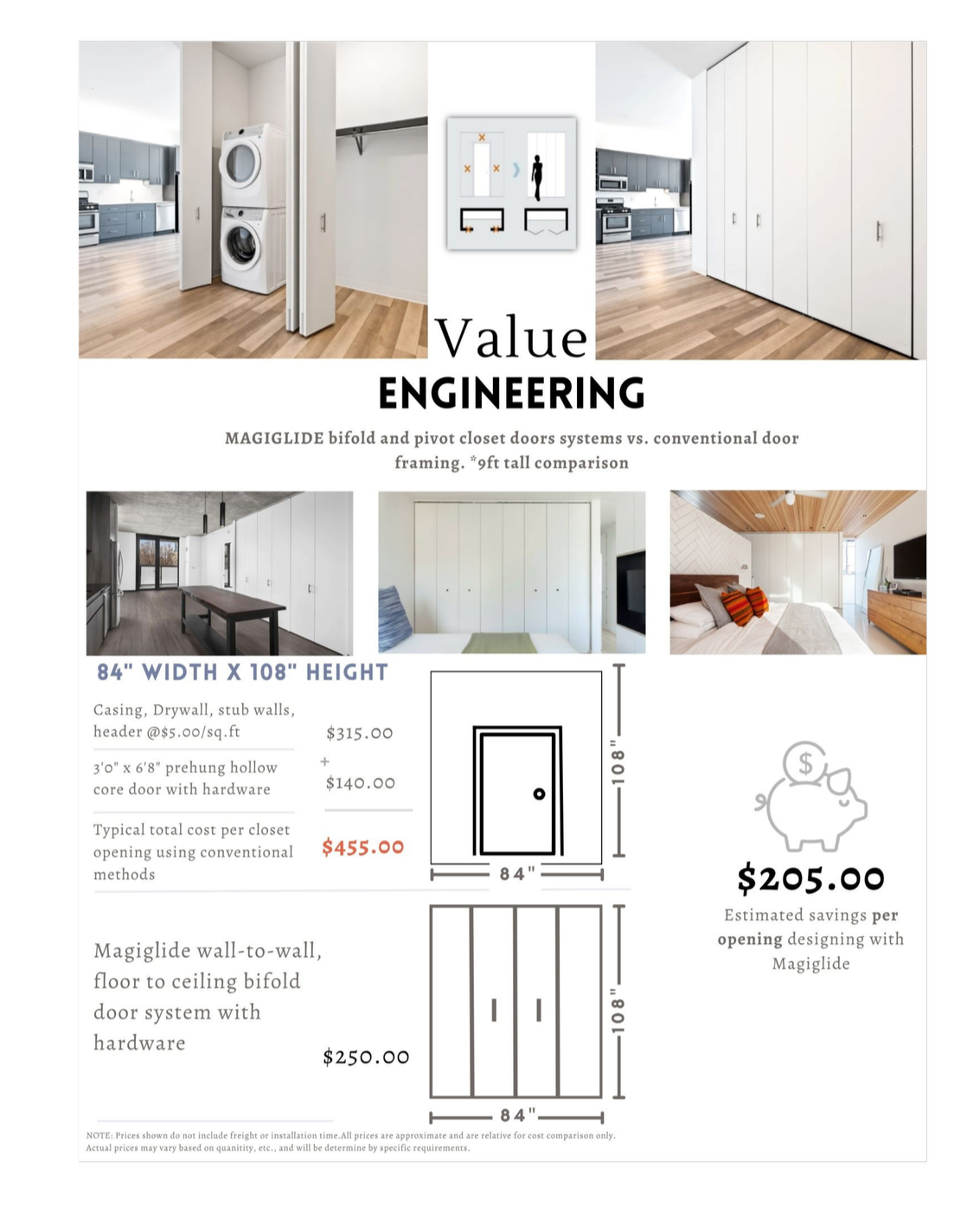
Floor-to-Ceiling Options (Up to 10ft): Replaces expensive drywall soffits and framing above closets, expanding usable room space and lowering framing CapEx. See our floor-to-ceiling options.
Pre-Fitted Construction: Reduces installation time per opening, allowing general contractors to complete fit outs ahead of schedule.
Protect Your Project ROI from Day One
With advertised rents averaging $930 per bed and annual rent growth slowing to roughly 2 percent nationally, student housing operators can no longer count on rising rents alone to offset preventable maintenance costs. Value engineering shouldn't mean sacrificing long-term durability. By specifying HUD-heavy-duty Magiglide® commercial bifold doors, developers and architects create living spaces that look better, last longer, and eliminate unnecessary maintenance costs — protecting NOI in a market where every basis point counts.
Source: Preleasing, rent, and market data referenced from the Yardi Matrix National Student Housing Report, July 2026.