
The Closet Door Is a Small Detail That Can Become a Big Maintenance Problem…
For general contractors, multifamily developers, and property management teams, post-occupancy performance is where many interior finish decisions are ultimately tested.
Flooring, cabinetry, countertops, plumbing fixtures, and appliances typically receive significant attention during value engineering. Closet doors, however, can be overlooked—even though they are opened and closed repeatedly throughout the life of a building.
When a closet door comes off its track, sags, binds, or develops damaged hardware, the problem quickly becomes more than an inconvenience for the resident.
It can become:
A maintenance work order
A tenant turnover repair
A warranty callback
An unexpected labor expense
A replacement-parts issue
Another task for an already stretched property management team
For multifamily construction, the right closet door specification is therefore about more than appearance and initial cost. It is about durability, installation, maintenance, and total cost of ownership.
That is the philosophy behind Magiglide® closet door systems from Landquist & Son.
Manufactured in the USA for multifamily new construction, renovation, and adaptive reuse, Magiglide has been used in multifamily housing since the 1950s. Landquist & Son has engineered the system around the realities of repeated everyday use—not simply the initial installation.
Understanding Multifamily Closet Door Failure Points
Not all bifold closet doors are engineered the same way.
A conventional residential-grade closet door may depend on relatively small components to carry, guide, and stabilize the panels. In a multifamily environment, those components can experience thousands of operating cycles, resident abuse, moving activity, and repeated maintenance adjustments.
The result is predictable: the weakest component eventually becomes the failure point.
Common Closet Door Failure Points
Component Common Failure Issue Multifamily Impact
Pivot hardware Pins or mounting points loosen or wear Door begins to sag or bind
Hinges Point-load hardware stresses panel edges Panels can separate or become misaligned, causing injury
Top track Track & components become damaged, fall out Door can become difficult to operate
Floor hardware Brackets loosen or become misaligned Door movement and alignment suffer
Door panels Lightweight construction damage during use or turnover Replacement or repair may be required
The important question for a project team isn't simply "What does the closet door cost?"
It is: "How is the closet door engineered to perform after the building is occupied?"
1. Continuous Hinge Design Helps Distribute the Load
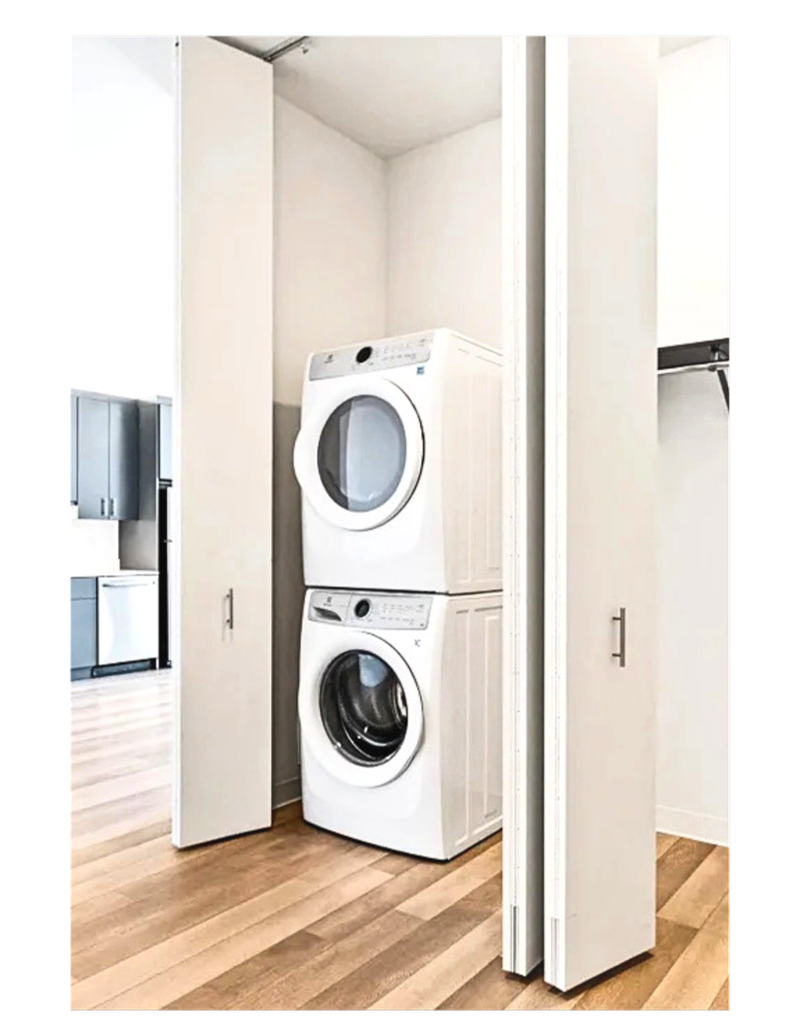
One of the defining features of the Magiglide® bifold system is its full-length heavy-duty structural piano hinge.
Instead of relying on a few small hinge points, the continuous hinge runs along the height of the panel and is embedded into kerfs within the solid-core particleboard panels. (Tempered steel pins secure the hinge to the panels with a butterfly system)
This approach matters in multifamily construction because the hinge isn't simply a decorative connection—it is a structural component of the door system.
Why it matters to the GC:
Helps maintain panel alignment
Distributes operating forces along the panel
Reduces dependence on individual hinge screws
Helps prevent panel separation
Supports long-term durability in high-use environments
Landquist & Son's GC resources specifically highlight the full-length piano hinge as a key part of the system's durability.
2. The Door Weight Doesn't Hang From the Top Track
Another important engineering distinction is how the door's weight is supported.
With Magiglide, the floor plate assembly carries the weight of the bifold and pivot door system. The assembly uses heavy-duty steel components, including 14-gauge cold-rolled steel saddle and floor pivot brackets with hardened steel pins and threaded studs.
The top track has a different job.
It guides the door—it doesn't carry the door's weight.
Landquist & Son uses a heavy-duty, aircraft-quality extruded aluminum top track specifically to guide the panels. Because the track is not carrying the door weight, the system is engineered for smooth, long-term operation.
For architects and contractors, this distinction is important during specification because track design and load distribution directly influence long-term door performance.
3. Extruded Aluminum Track vs. Lightweight Track Systems
The track is one of the most frequently overlooked components of a bifold closet door.
Magiglide uses an extruded aluminum top track with a nylon guide designed to help keep the bifold from falling out of the track.
That is a very different approach from treating the track as a lightweight accessory.
For multifamily projects, the track needs to withstand repeated operation while maintaining alignment and guiding the panels correctly.
This becomes particularly important during:
Resident move-ins and move-outs
Furniture deliveries
Apartment turnover
Routine maintenance
Repeated daily use
Renovation and adaptive reuse projects
A durable closet door system should be designed around those conditions from the beginning.
4. Solid-Core Construction Makes a Difference
Hardware is only part of the equation.
The door panel itself needs to be capable of handling the stresses placed on it.
Magiglide solid-core bifold and pivot panels use high-density industrial-grade particleboard, with a standard 45 lb. density core. Landquist & Son also offers additional core options.
The result is a door system designed around rigidity and durability rather than lightweight residential construction.
Magiglide bifold systems are available in both:
Standard Series — 3/4" thick
Advantage Series — 1-1/8" thick
The two configurations allow project teams to select the appropriate door thickness based on the project requirements.
The Hidden Cost of Multifamily Closet Door Failure
The initial purchase price of a closet door is only one part of the equation.
For multifamily owners and operators, the more important metric is total cost of ownership.
Consider what happens when a closet door fails after occupancy:
Resident reports problem → Maintenance receives work order → Technician diagnoses issue → Parts are sourced → Repair is scheduled → Resident access is coordinated → Repair is completed → Work order is closed.
That process consumes labor and time even when the failed component itself is inexpensive.
Multiply that process across hundreds of apartments and multiple years of ownership, and a seemingly minor product decision can become an ongoing operational expense.
This is why value engineering should not focus exclusively on upfront material cost.
The better question is:
What closet door system delivers the lowest practical lifecycle cost for the building?
Designing for Fewer Multifamily Maintenance Callbacks
A durable closet door specification starts well before installation.
For architects and project teams, Landquist & Son provides technical resources intended to make the specification process easier, including specifications, Revit files, CAD/section information, installation details, and product documentation.
That allows the closet door to be considered during the design and specification phase, rather than treated as an interior finish decision after the major building systems have already been selected.
Consider these factors during specification:
1. Door construction
Specify a solid-core panel appropriate for the demands of multifamily housing.
2. Hinge construction
Look for a full-length structural hinge rather than relying exclusively on small point-mounted hinges.
3. Load distribution
Understand where the weight of the door is being carried.
4. Track construction
Specify a durable extruded aluminum track engineered for the intended application.
5. Custom sizing
Don't automatically design around a one-size-fits-all opening. Magiglide doors can be custom manufactured to project dimensions, allowing architects and contractors greater flexibility during design.
6. Installation
Proper installation is critical to long-term performance. Landquist & Son provides installation instructions and technical guidance to help eliminate the learning curve in the field.
Custom Closet Doors Can Be a Value Engineering Strategy
Value engineering doesn't always mean selecting the least expensive product.
Sometimes the better strategy is to select a product that eliminates unnecessary construction, maintenance, or replacement costs.
Because Magiglide closet doors are custom manufactured, project teams can design around the actual opening rather than forcing the opening to conform to a standard closet door size. Landquist & Son manufactures custom sizes to project requirements, including doors up to 10 feet in height for applicable configurations.
That flexibility can create opportunities during both new construction and renovation.
On projects such as adaptive reuse, where existing structural conditions and unconventional openings can make standardized products difficult to accommodate, custom closet doors can become particularly valuable.
Landquist & Son has supplied Magiglide systems for multifamily renovation and adaptive reuse projects, including large residential conversions where maximizing usable space and adapting to existing building conditions are important considerations.
Built for Multifamily. Specified for Long-Term Performance.
Landquist & Son approaches closet doors differently because the company specializes in multifamily closet door systems.
The Magiglide® system combines:
Solid-core bifold, pivot, and bypass doors
Full-length structural piano hinges
Heavy-duty extruded aluminum track
Steel floor plate assemblies
Custom sizing
Multifamily-focused engineering
Technical specifications and CAD/Revit resources
USA manufacturing
The system is also designed without a floor track for Magiglide bifold applications, helping preserve accessibility and usable floor space.
For architects, that means a closet door system that can be incorporated into the design early.
For general contractors, it means a system with defined installation requirements and technical documentation.
For developers and property managers, it means selecting an interior product with long-term performance in mind.
Multifamily Closet Door Specification Checklist
Before approving a closet door submittal, ask:
Is the door designed specifically for multifamily use?
Is the panel solid-core and appropriate for repeated use?
Does the hinge distribute the load along the full height of the panel?
How is the door weight supported?
Is the track engineered for long-term durability?
Can the door be custom sized to the actual opening?
Are installation details and technical drawings readily available?
Are Revit and specification resources available to the design team?
What warranty is provided?
What is the expected lifecycle and maintenance requirement?
These questions move the conversation from initial product cost to building performance.
The Bottom Line for General Contractors and Developers
Closet doors may represent a relatively small line item in a multifamily construction budget, but they interact with residents and maintenance teams every day.
That makes durability an important part of the specification.
The goal shouldn't simply be to install a closet door that works on the day the project receives its certificate of occupancy.
The goal should be to specify a multifamily closet door system engineered to keep working after hundreds of residents, thousands of operating cycles, multiple turnovers, and years of occupancy.
That's where engineering matters.
And that's where Magiglide® by Landquist & Son is different.