
E9: Student Housing
The Evolution and Rise of Student Housing: Lessons from the Past Decade and What’s Next
Over the past decade, the landscape of student housing in the United States has undergone a dramatic shift. What once was a relatively stable world-where colleges provided most of the beds students needed and off-campus rentals filled the gap- has become a complex and often contentious mix of on-campus expansion, off-campus competition, affordability struggles, and strategic investment by universities and private developers.
The Early Boom: Off-Campus Housing Takes Root
In the late 2010s and early 2020s, rising enrollments at major universities collided with an on-campus housing supply that hadn’t kept pace. Students increasingly turned to off-campus housing — apartments, shared houses, and purpose-built developments near campuses — to meet growing demand. In many college towns, this led to a proliferation of rentable units within walking distance of campus as private developers recognized student housing as a resilient market segment. National data from industry trackers suggested that millions of new beds were delivered in this period as universities and investors raced to serve a booming student population.
This boom wasn’t just about quantity; it was about preference. Many students who had fewer on-campus options began seeking portions of their college experience in off-campus communities that offered amenities, privacy, and often more flexible lease terms than traditional dorms. High-speed internet, private bedrooms, and proximity to local businesses became key features of what renters considered “ideal” student housing.
Yet this boom came with challenges. In towns where rents spiked faster than local incomes, students found themselves competing for limited affordable options — sometimes paying more than their peers in the broader rental market just to be near campus. In cities like San Antonio and Austin, rents for student tenants grew rapidly, intensifying affordability concerns.
A Tight Market, Rising Rents, and a Shift Back Toward Campus
By the mid-2020s, the limitations of relying on off-campus sources became clearer. With ever-higher rents, limited inventory close to campuses, and a tightening overall housing market, many students found themselves priced out or forced into less desirable living situations. Meanwhile, on-campus options lagged as universities struggled to add beds quickly in dense core areas. Research shows that while many students prefer to live near or on campus, the number of on-campus beds relative to enrollment has fallen at some flagship institutions, further straining the market.
These pressures highlighted a fundamental lesson: off-campus housing alone couldn’t solve the housing crunch. Students wanted affordability and stability; families valued safety and proximity; and campuses recognized that housing availability could directly affect recruitment and retention.
University of Michigan: A Case Study in Strategic Expansion
Few institutions illustrate the shift back toward on-campus investment better than the University of Michigan. For years, the university struggled to meet housing demand, with enrollment rising but housing capacity failing to keep pace. Students often found themselves competing for a limited number of rooms, while many returning students were left scrambling for off-campus leases in an expensive Ann Arbor rental market.
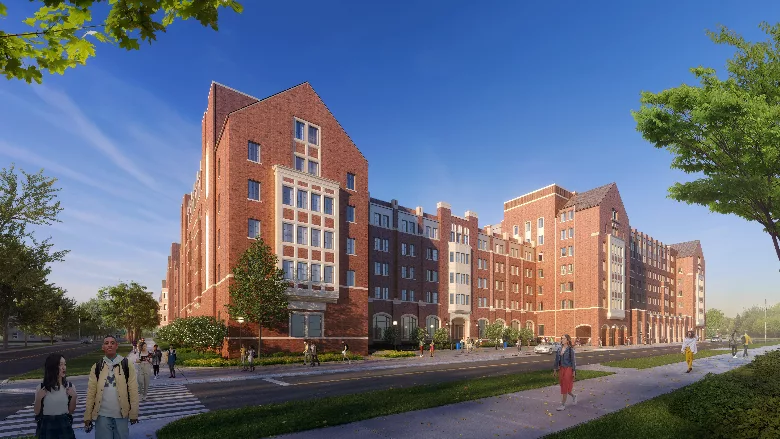
U of Michigan, mich.edu
In response, U-M launched one of the most ambitious student housing projects in the country: a 2,300-bed residence hall on Central Campus — the first major residence built specifically for first-year students since the 1960s. This development, expected to welcome students in fall 2026, represents one of the largest third-party housing investments in U.S. higher education.
This project isn’t just about adding beds. It reflects broader trends in student-centric campus planning:
Affordability and accessibility: By increasing on-campus options, U-M hopes to relieve pressure on the off-campus rental market, making housing more accessible for students who might otherwise face steep rents.
Sustainability and innovation: New residence halls incorporate energy-efficient systems and sustainable design, a response to student demand for environmentally responsible living environments.
Strategic campus planning: Central Campus expansion prioritizes location, walkability, and integration with academic and social life, strengthening the connection between residential life and student success.
What the Next Decade Holds
The broader student housing industry is at a crossroads. High leasing performance in recent years suggests demand remains robust, but affordability — whether on or off campus — is top of mind for students and families alike.
Universities are learning that:
Purpose-built solutions matter: Too much reliance on off-campus supply leaves housing needs vulnerable to wider real estate market pressures.
Integrated planning pays off: Campus housing tied to academic core areas fosters engagement and community.
Affordability drives access: Students weigh cost heavily; housing insecurity can affect academic outcomes.
Take a look below at a graph generated by Matthews*, CoStar Group, Inc, RealPage, Inc. expressing the stabilization of student housing rents compared to multifamily overall through the 2nd quarter of 2025.
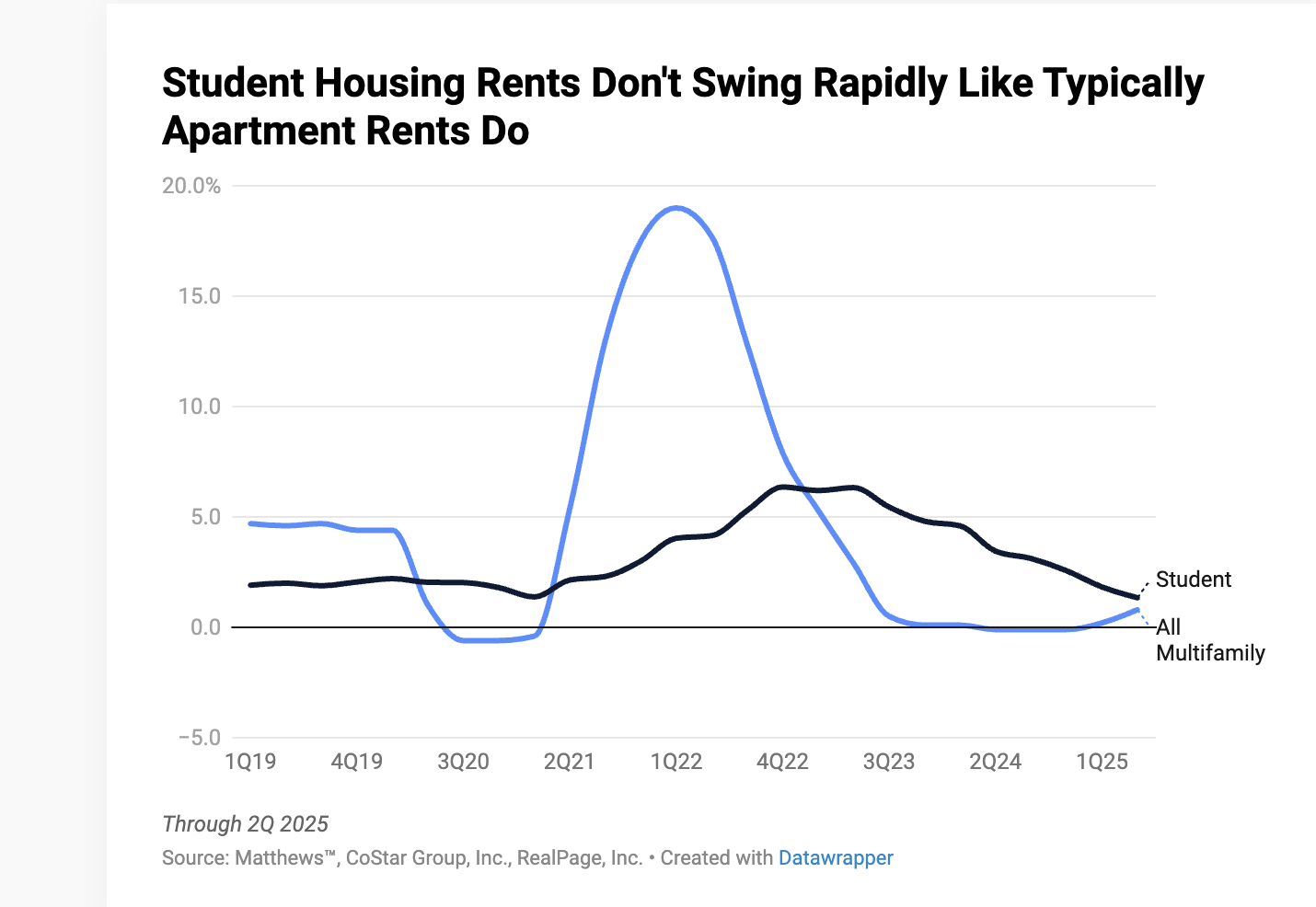
This graph truly highlights the stabilizing rent reaches for private investors. This offers a more dependable market for outlook, but maybe not one that you will strike your ROI like an investment into Google in 2004 if you know what I mean. . .
A few notable projects that are currently planned or being built throughout the nation currently to address this demand include:
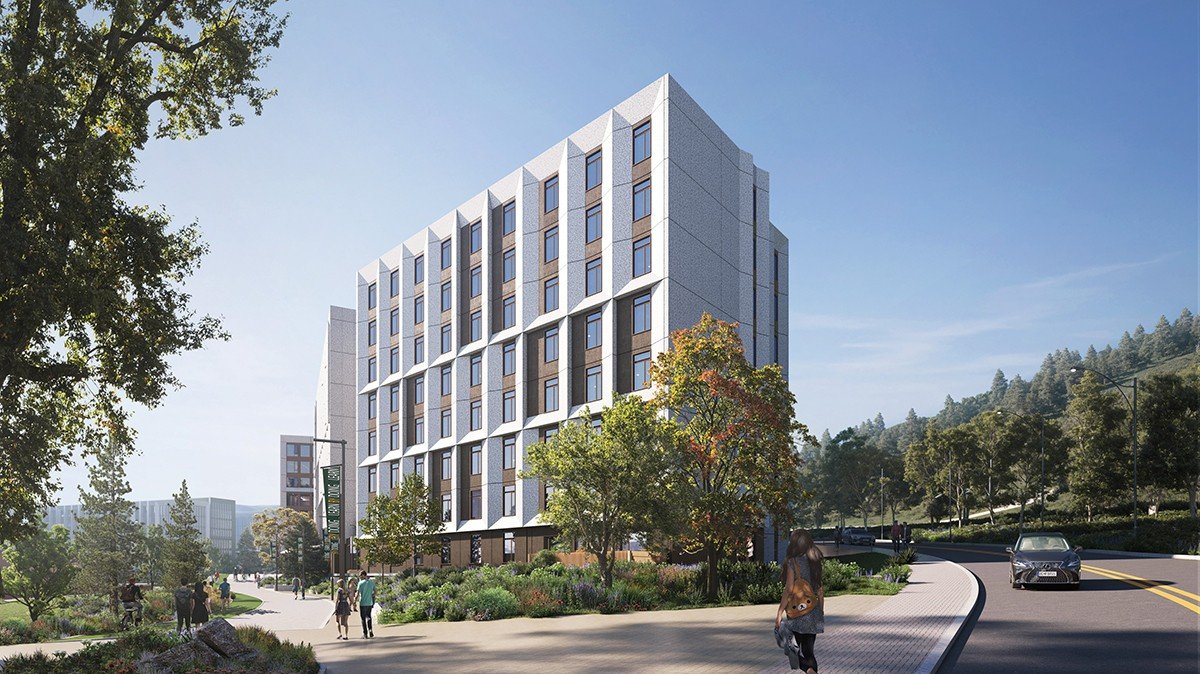
California Polytechnic State University (Cal Poly) Modular Housing Expansion
~4,200 beds across nine new residence buildings-one of the largest planned university housing expansions in the U.S.
Architect: Steinberg Hart
Developer: FullStack Modular
Design-Build Contractor: The Whiting-Turner Contracting Company
An interview with FullStack Modular.
In order to get a better look into modular, what better way than to interview the firm that is currently working on Cal Poly. FullStack Modular is a firm located in Carson, California, that specializes in exactly what their name entails. BIM specialist at FullStack Modular, Armando Pastora was asked the following questions.
Q: From a BIM perspective, what makes student housing particularly well-suited for modular construction?
A: Student housing is especially well-suited for modular construction because of its repetitive program and standardized room layouts. From a BIM perspective, repetition allows for high levels of coordination, prefabrication detailing, and digital prototyping before fabrication begins. When properly modeled, modular student housing benefits from precise clash detection, controlled geometry, and repeatable unit configurations, which significantly reduce field uncertainty and improve quality consistency.
Q: What are the most common design mistakes you see when architects transition from traditional to modular thinking?
A: One of the most common challenges is designing modular projects using traditional construction logic. Modular requires early consideration of transportation limits, structural stacking tolerances, connection details, and manufacturing sequencing. Another frequent issue is delaying coordination between design and fabrication teams. Modular projects demand early alignment between architecture, structure, MEP, and manufacturing constraints to avoid redesign later in the process.
Q: At what stage should architects bring a modular manufacturer into the design process to maximize efficiency?
A: Ideally, the modular manufacturer should be involved during early schematic design. Early collaboration allows the team to align grid logic, module dimensions, structural systems, and building envelope strategies before decisions become difficult to reverse. The earlier manufacturing intelligence is integrated into the design process, the greater the efficiency gains in cost, schedule, and constructibility.
Q: What schedule advantages are realistic for mid-rise student housing when modular is executed correctly?
A: When executed correctly, modular construction can significantly compress project schedules by overlapping site work and module fabrication. While results vary by project, it is realistic to see meaningful reductions in overall duration compared to traditional construction. The key is not just prefabrication itself, but disciplined coordination, early design integration, and clear sequencing strategy.
So in summary, student housing’s repetitive layouts make it one of the most efficient building types for modular delivery. With early BIM coordination, precise digital prototyping, and manufacturer involvement during schematic design, teams can reduce field uncertainty, improve quality control, and compress schedules by overlapping fabrication with site work.
The key, however, is a shift in mindset: modular success depends less on prefabrication alone and more on early alignment between architecture, engineering, and manufacturing.
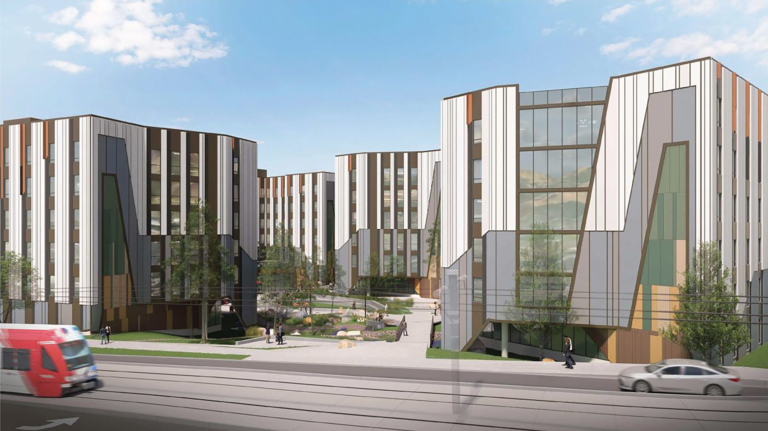
University of Utah- On-Campus Housing Master Plan
~5,000 beds planned as part of a large phased housing expansion, set to double the on-campus housing sock.
Architect: Ayers Saint Gross & MHTN Architects
Developer: American Campus Communities & P3
General Contractor: Okland Construction
As institutions like the University of Michigan, California Polytechnic State University, and University of Utah push forward with large-scale, thoughtful housing initiatives, the hope is that colleges nationwide can turn lessons from the boom and bust of the last decade into strategies that support students — both economically and socially — for years to come.
Until the next door opens,
Tracy