
E10: Zoning Reform in Texas
Last week, Landquist and Son spent time in Dallas, meeting with architectural partners and engaging in conversations shaping the future of multifamily housing across Texas. While discussions ranged from design efficiency to long-term building performance, one topic surfaced repeatedly: the pace and scale of zoning reform underway in major Texas markets—and what those changes mean for how multifamily projects are planned, designed, and built. As cities like Dallas, Houston, and Austin respond to unprecedented population growth and housing demand, zoning is no longer just a regulatory consideration—it is actively redefining the form, density, and durability expectations of multifamily construction.
Here is a detailed look at the most recent zoning changes in Dallas, Houston, and Austin- including actual reforms with dates, population data, legal context, and what it means for multifamily design there.
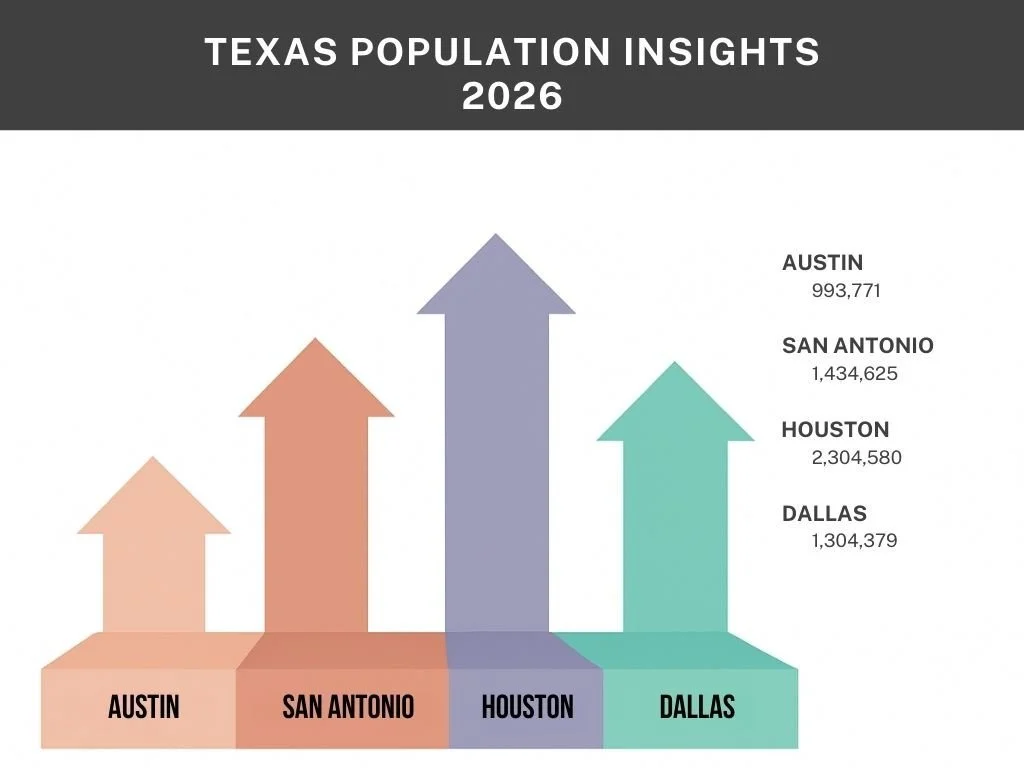
Population Pressures: Why Change is Urgent. 🏙️
These four cities are among the fastest-growing in the United States and are all located in Texas. The numbers below show the current population as of the most recent census.
To put this in comparison with other major US cities. (Data found from census.gov)
New York: ~8.26 million
Los Angeles: ~ 3.82 million
Chicago:~ 2.67 million
Miami:~509,107
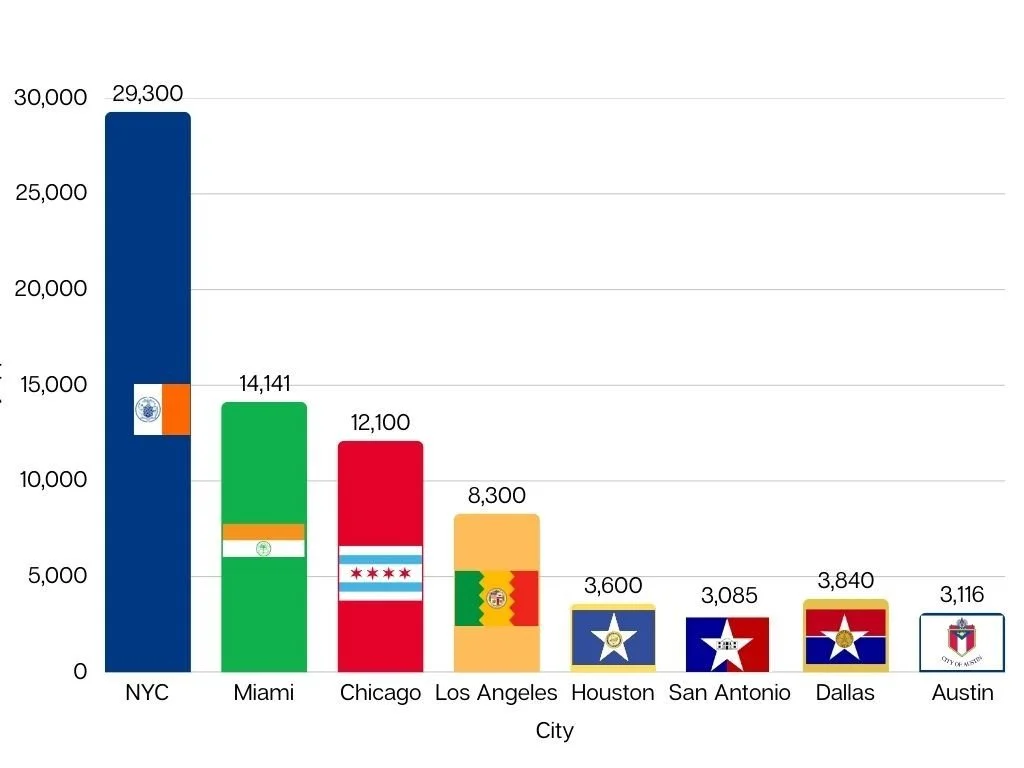
When looking for high-density growth in a city, it is important to also evaluate the land area of that populated city, resulting in a density score in (people/mi²). This will show the importance of urban infill in an area, resulting in a tower landscape.
Taking a look below, the density results are in for the cities evaluated. Placing New York well above the rest in terms of (people/mi²).
The data shows that Texas cities are much more sprawling than the top US cities. The lower density in Texas provides space for multifamily expansion but also longer development timelines and higher infrastructure costs. This reflects different land use traditions-often including larger lots, less restrictive height limits, and more automobile-oriented development. As Texas cities update codes and respond to statewide reforms, comparing them to these density benchmarks helps illustrate how zoning changes could move markets closer to more urban, higher-density forms seen elsewhere in the U.S.
In contrast, NYC, Chicago, LA, and Miami achieve high density in smaller footprints, driving different zoning and multifamily design pressures.
Density Comparison Chart per city (ppl/mi²)
Texas Statewide Reform That Affects Every City
In June 2025, the Texas Legislature passed Senate Bill 840 as part of a trio of housing-focused laws signed by Governor Greg Abbott, with the reforms going into effect on September 1, 2025.
Key Features of SB 840
By-right multifamily & mixed-use development: Cities must allow multifamily and mixed-use residential uses in districts that allow commercial, office, retail, or warehouse uses without requiring a zoning change, discretionary permit, or special approvals.
Density & form limits: Municipalities cannot enforce certain restrictions on density (e.g., limits more restrictive than 36 units per acre), height (minimum 45 ft), setbacks (> 25 ft), or floor-area ratios for these types of developments.
Parking reform: Cities cannot require more than one parking space per dwelling unit or mandate multi-level structured parking for mixed-use or multifamily developments under this law.
Streamlined conversions: Converts office, retail, or warehouse buildings constructed at least five years prior into mixed-use or multifamily uses without burdensome traffic studies or discretionary reviews.
This law applies to cities with populations above 150,000 and county populations above 300,000 — effectively covering Dallas, Houston, Austin, and many large Texas suburbs. It marks the most impactful statewide shift in how multifamily housing can be developed in decades.
📍Houston: No Traditional Zoning, But Still Changing
Houston remains unique because it does not have a traditional city zoning code — meaning land-use restrictions are largely shaped by deed restrictions, minimum lot sizes, and development standards rather than conventional zoning districts.
Lot-Size Reform Impacts
Research shows that relaxing minimum lot-size requirements — specifically reducing them from 5,000 sq ft to 3,500 sq ft — enabled the construction of 34,000+ townhomes between 2007 and 2020, automatically increasing housing density on formerly non-residential parcels.
Even without formal zoning, Houston is now affected by SB 840 because it removes local requirements tied to parking, setbacks, and density when redeveloping commercial parcels into residential, which was previously subject to development standards that could act as de facto zoning obstacles.
📍Austin: “HOME” Code and Lot-Type Reforms
Austin has pursued aggressive land-use reforms aimed at reducing housing costs and increasing multifamily options across the city.
HOME Code Amendments (Phase 1 & Phase 2)
The CITY adopted the Home Options for Mobility and Equity or “HOME” Amendments with key milestones:
Dec. 7, 2023: HOME Phase 1 code adopted
Feb. 5, 2024: Phase 1 development applications accepted
May 16, 2024: HOME Phase 2 adopted
Aug. 16 & Nov. 16, 2024: Phase 2 citywide applications accepted
Mar. 6 & Jun. 16, 2025: Additional infill and Site Plan Lite reforms adopted, expanding small multifamily builds in formerly single-family zones.
The HOME reforms allow up to three units (duplex or triplex) in traditional single-family zones and relax unrelated adult occupancy restrictions — making it easier to build gentle density without special exceptions. Austin’s reforms also complement state law (SB 840) and include evolving strategies for compatibility buffers, lot sizes, and infill standards to encourage multifamily housing in more neighborhoods.
📍 Dallas — Zoning Reform & Multifamily Development
1. Texas Senate Bill 840 — “By-Right” Multifamily (Effective Sept 1, 2025)
A major state law, Senate Bill 840 (SB 840), took effect statewide on September 1, 2025 and significantly reshapes multifamily development in big Texas cities, including Dallas. It requires cities with populations over 150,000 (in counties over 300,000) to allow multifamily and mixed-use residential development “by right” in areas zoned for commercial, office, warehouse, retail, or mixed-use — without rezoning or discretionary approvals. Cities also can’t impose restrictive limits on density, height, setbacks, or parking below what applies to those already-allowed uses.
Key impacts for Dallas under SB 840:
Multifamily may be developed on commercially zoned land without rezoning.
Density must be at least 36 units per acre or the highest allowed locally.
Height limits may not be below what commercial buildings allow (often 45 ft) and cities can’t add extra parking minimums.
Parking maximums are now capped at one space per dwelling unit for qualifying multifamily projects.
This effectively expands the geographic range where multifamily housing can be built, particularly along commercial corridors and near transit, by removing many downzonings or special approvals that historically slowed projects.
2. Dallas Development Code Rewrite (2025–2026)
Dallas is working on its first comprehensive zoning code overhaul in decades, aimed at modernizing the outdated rules and incorporating state law changes. The diagnostic phase took place in early 2025, with draft code texts expected in spring 2026 and potential final adoption in late 2026 or early 2027.
Highlights of the proposed code rewrite include:
Consolidating zones into a modern structure (Chapter 63) and streamlining regulations.
Creating “gentle density” districts to allow duplexes, triplexes, and small multifamily in more areas by right.
Reducing reliance on discretionary approvals and making standards more objective (less negotiation).
At the same time, Dallas updated its parking code in May 2025, eliminating many rigid minimums and giving context-sensitive flexibility (e.g., near transit) while still applying minimums in some multifamily situations.
📍 San Antonio — Zoning Context & Multifamily Dynamics
1. State Law Influence — SB 840 & Others
Just like Dallas, SB 840 applies in San Antonio, allowing multifamily and mixed-use residential in commercial zones without rezoning and removing certain local discretionary hurdles. Developers can propose apartments where office, retail, or industrial uses are permitted — and cities cannot impose more restrictive density, height, parking, or setback requirements than what state law allows.
Alongside SB 840, other 2025 state laws such as SB 15 (small lot rules) and SB 2477 (office-to-residential conversions) are intended to streamline both small lot housing and adaptive reuse of underused commercial buildings into multifamily.
2. Local Zoning Tools — Infill & Corridor Strategies
San Antonio hasn’t undertaken a sweeping zoning overhaul like Dallas, but it does employ flexible zoning districts aimed at encouraging infill and walkable redevelopment. One example is the Infill Development Zone (IDZ), a specialized district that lets developers work with variable setbacks, heights, parking waivers, and open space requirements to transform underused land into higher‐density residential and mixed-use projects. (IDZ)
This type of zoning supports multifamily growth in areas with existing infrastructure and potential density without needing broad upzoning across the city, though it still requires rezoning case approvals for each property.
3. Rezoning Activity & Implementation Challenges
San Antonio’s planning and zoning commission continues to approve rezonings that allow multifamily units in areas that were previously lower-density, showing incremental shifts. While specific multifamily rezoning cases are periodically heard and approved, a comprehensive citywide reform package hasn’t been adopted yet.
At the same time, historical procedural barriers — such as supermajority requirements for zoning changes when nearby property owners oppose them — have complicated affordable housing and multifamily projects in the past, although efforts to reform these laws are ongoing.
Local Context Matters — But the Risk Profile Has Changed
While state law sets the floor, local implementation still matters:
Dallas is in the midst of a comprehensive zoning code rewrite aimed at modernizing land-use categories, reducing discretionary approvals, and allowing “gentle density” and mid-rise multifamily in more locations. For developers, this signals greater long-term predictability, especially along commercial corridors and transit-adjacent sites.
San Antonio continues to rely heavily on targeted tools such as its Infill Development Zone (IDZ), which offers flexibility on height, setbacks, and parking. While rezonings are still common, SB 840 now allows developers to prioritize commercial parcels where entitlement risk is lower and timelines are shorter.
Houston, already known for its minimal zoning structure, benefits from SB 840 primarily through parking and density standardization, reinforcing its attractiveness for higher-density multifamily and mixed-use development.
Austin pairs state reforms with aggressive local housing initiatives, especially near transit corridors, where height bonuses and reduced parking further enhance multifamily viability.
Developer Implications: How Zoning Now Shapes Site Selection
These reforms materially change how developers should evaluate multifamily opportunities in Texas:
1. Commercial Land Has Become Residential Land Retail strips, underutilized office parks, and aging commercial corridors are now among the most valuable multifamily development sites — often without rezoning risk.
2. Speed to Market Is Faster By-right development reduces entitlement timelines, lowers carrying costs, and improves underwriting certainty — especially critical in volatile interest-rate environments.
3. Density Is More Predictable With minimum density protections in place, developers can underwrite unit counts with greater confidence and design projects that fully utilize site potential.
4. Design Flexibility Is Increasing Reduced parking mandates and consistent height standards allow architects to prioritize unit mix, amenity programming, and façade articulation rather than designing around zoning constraints.
5. Secondary and Transitional Locations Are Now Viable Sites previously dismissed due to zoning friction — especially outside CBDs — are becoming feasible for mid-rise and high-density multifamily, expanding the geographic footprint of development.
The Bottom Line
Texas zoning reform is quietly but decisively reshaping multifamily development strategy. For developers, success over the next cycle will hinge less on rezoning prowess and more on identifying commercially zoned sites with strong fundamentals, understanding state-level protections, and aligning early with architects who can design efficiently within these new frameworks.
In today’s Texas markets, zoning is no longer the first hurdle — it’s part of the competitive edge.
Anthony Chan, at DNA Workshop located in Plano, Texas, was asked what his thoughts were regarding design implications surrounding these zoning reforms in the state of Texas.
“I believe we will greatly benefit from the reform. It will be easier for multifamily buildings to develop into "villages" or "micro cities." Small theaters, parks, museums, and groceries. The new can be blended with many things. It is comparable to the open concept that we have modified for our homes. We adopt a more contemporary lifestyle when we open up the kitchen, opening up new options. I believe that making a few little changes to the current regulations will be very helpful.”

Houston
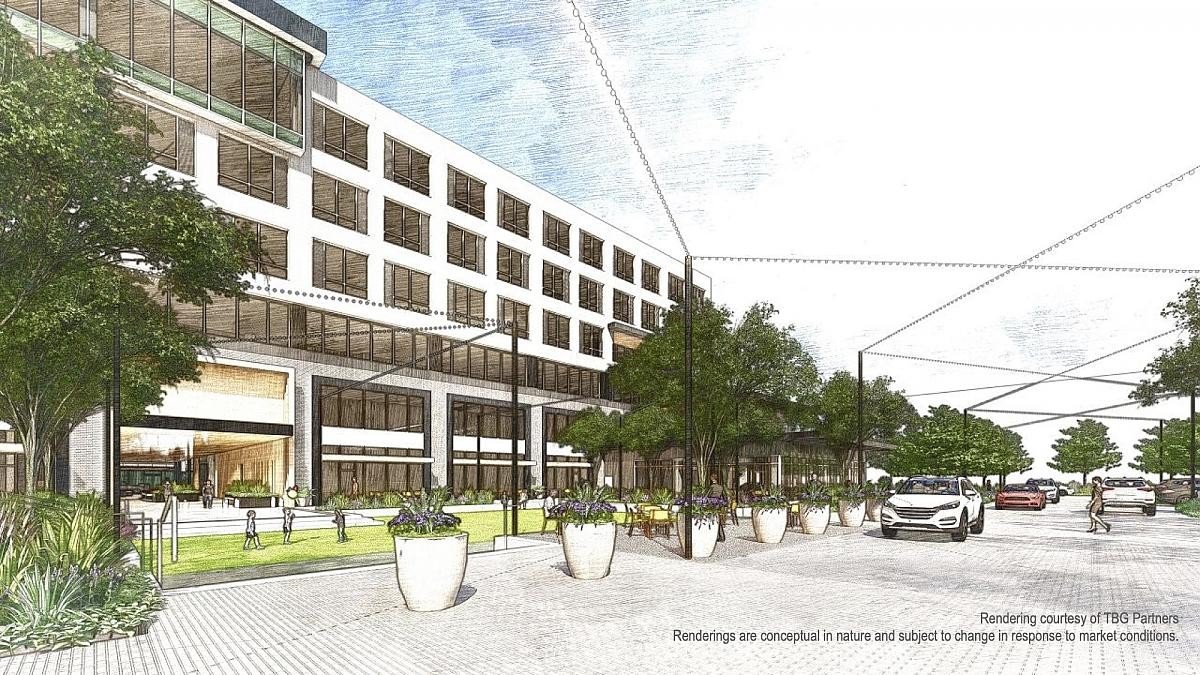
Rendering of Park 8 Place, Houston
Park Eight Place is a transformative, 70-acre mixed-use development in Houston’s Westchase area that exemplifies how contemporary land-use policy is encouraging walkable, higher-density districts outside traditional urban cores. The project has been designated under Houston’s Walkable Places ordinance, a local policy that incentivizes pedestrian-oriented design by relaxing certain development constraints (such as higher parking minimums and street frontage standards) in exchange for enhanced walkability and connectivity — a model that aligns with recent state-level reforms aiming to expand multifamily and mixed-use development opportunities. Expected to deliver thousands of residences alongside office, retail, and public space through 2026–2027, Park Eight Place illustrates how evolving regulatory frameworks can unlock large-scale, transit-friendly development on formerly underutilized land. (Houston Public Media link)
Developer: Johnson Development Corp
Architect: Gensler
San Antonio
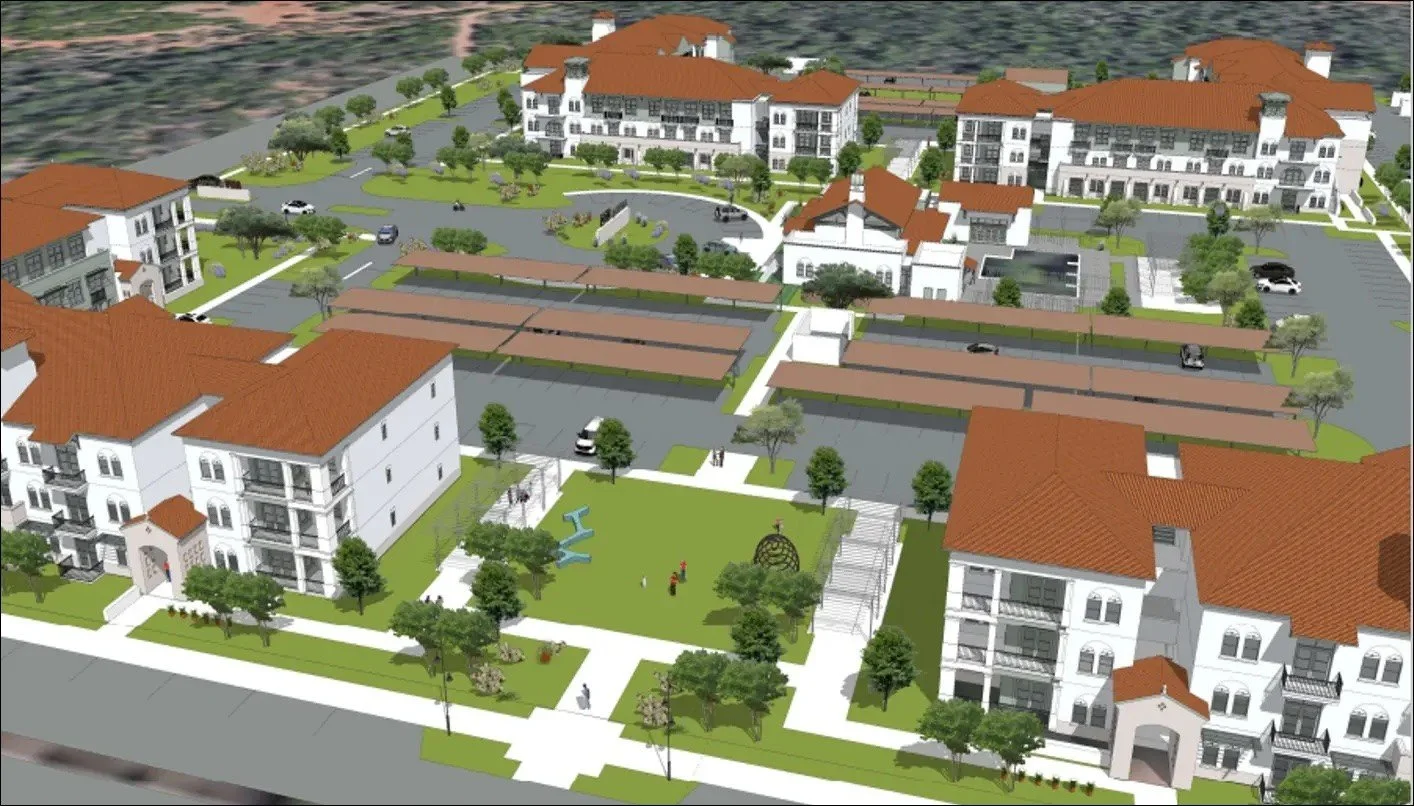
Aspire @ VIDA, San Antonio rendering
In San Antonio, the Aspire at VIDA project is one of the region’s most significant multifamily developments currently underway, with construction expected to continue through early 2027. Developed by Mission Development in partnership with CLX Ventures, this 300-unit, Class-A rental community is being built on roughly 12 acres across from Texas A&M University–San Antonio, strategically positioned near major employers like University Health Palo Alto Hospital and Toyota Manufacturing of Texas.
From a land-use and zoning perspective, Aspire at VIDA illustrates how San Antonio’s planning frameworks — including comprehensive and neighborhood zoning provisions — are enabling higher-density housing in locations targeted for growth. While the city still relies on case-by-case rezoning and design reviews in some areas, the fact that this project is advancing highlights how local zoning, combined with broader supportive policy signals (such as multifamily-friendly interpretations and public-private partnerships), can unlock larger multifamily communities in corridors where services, transit connections, and job clusters are concentrated. (CRE Daily)
Developer: Mission DG & CLX Ventures
Architects: GRG Architects
General Contractor: Concept Builders
Austin
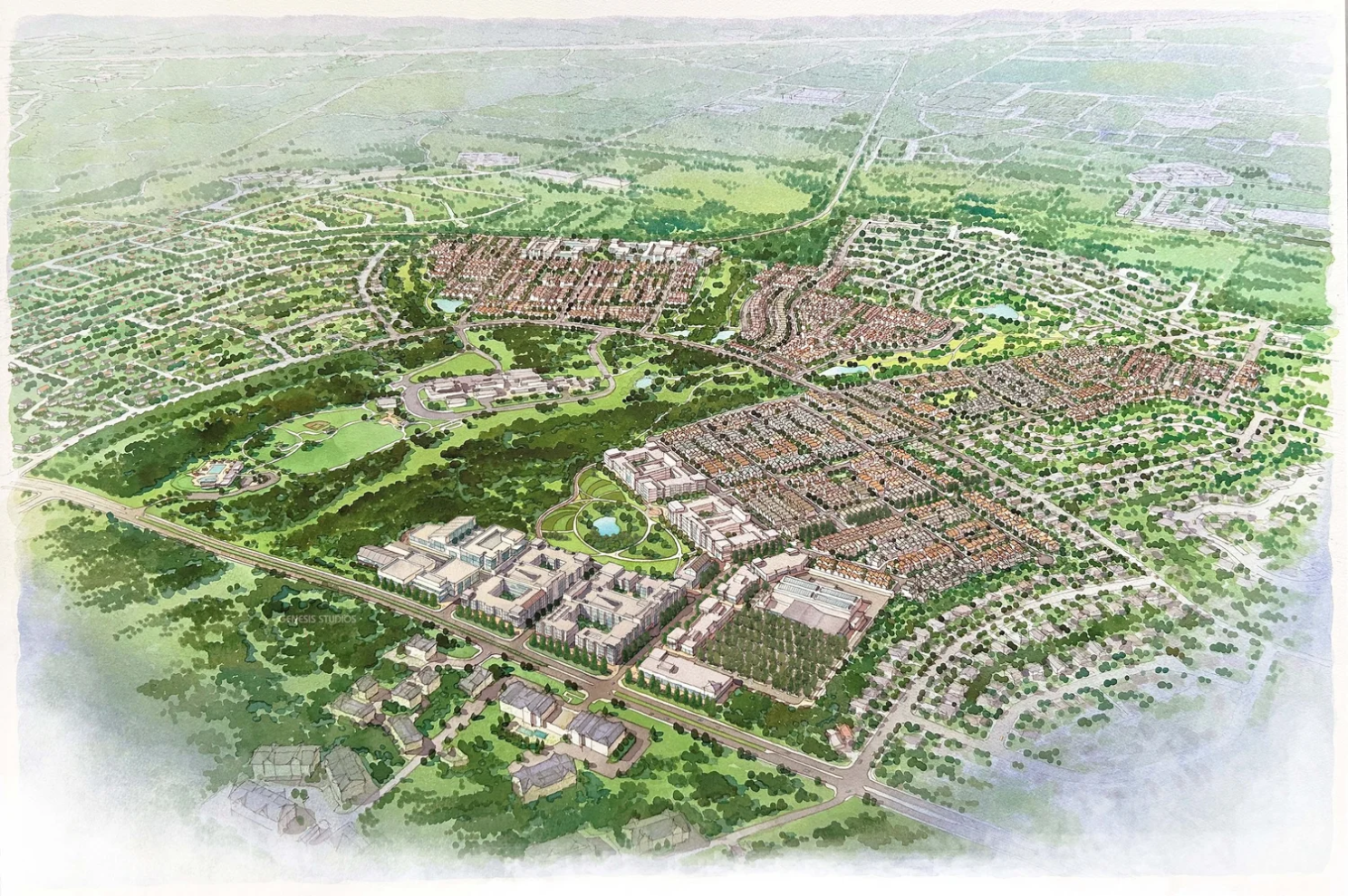
Colony Park, Austin rendering
In Austin, the Colony Park Sustainable Community will be a transformative 208-acre master-planned area led by Catellus Development Corporation in partnership with the City of Austin. Expected to break ground on infrastructure in 2026, the project is envisioned to deliver up to 3,000 residential units (including multifamily apartments and single-family homes), roughly 230,000 sq ft of office/institutional space, 130,000 sq ft of retail, and more than 40 acres of parks and open space.
From a land-use standpoint, Colony Park reflects how structured zoning and planned unit development (PUD) changes can drive equitable growth: the City Council has approved ordinances and a Tax Increment Reinvestment Zone (TIRZ) to support infrastructure and incentivize the development of mixed-income housing and commercial uses. These planning tools — coupled with the community-driven master plan — demonstrate how zoning can be used proactively to shape large-scale multifamily and mixed-use growth, rather than merely reacting to individual projects. (Austin.gov)
Developer: Catellus Development Corporation
Dallas
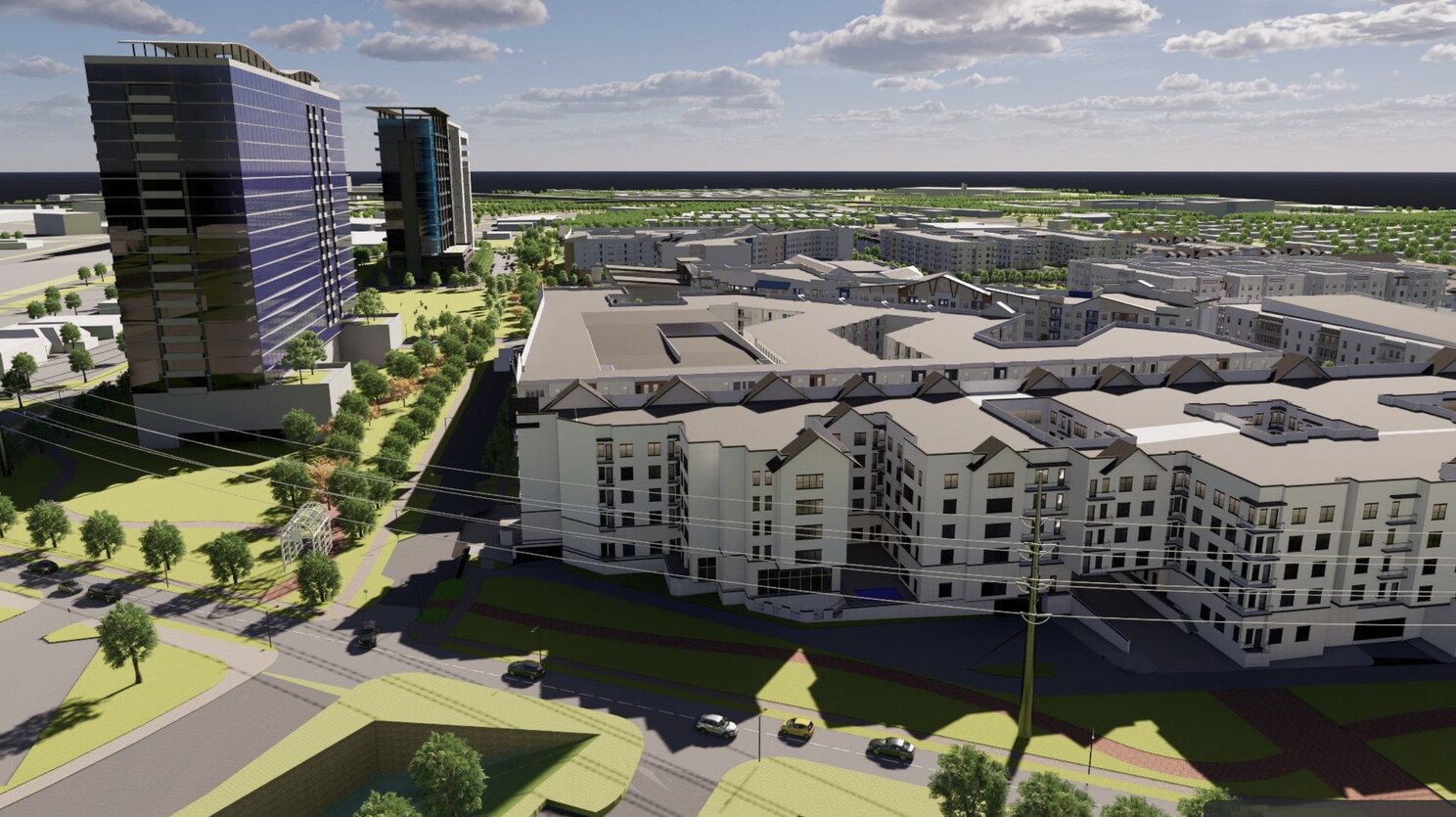
Collin Creek, Plano rendering
The $1 billion Collin Creek redevelopment in Plano is transforming the long-vacant Collin Creek Mall site into a vibrant, mixed-use live-work-play district featuring thousands of homes alongside retail, office, parks, and trails. Once complete, the master plan is projected to include approximately 2,300 multifamily units, 500 single-family homes, and 300 independent living residences spread over 115+ acres of redeveloped land, with retail, dining, and office components continuing into 2026–2028 and beyond.
What makes Collin Creek notable from a zoning perspective is the level of city-developer coordination needed to unlock such a large suburban site — including preliminary site plan approvals for multifamily housing and updated zoning to accommodate walkable densities and mixed use in an area historically dominated by retail and surface parking. This illustrates how evolving local planning frameworks (now supplemented by state reforms like SB 840) are facilitating large-scale multifamily and mixed-use projects in major Texas metros by reducing traditional entitlements and encouraging flexible land use.
Developer: Centurion American
Architect: Merriman Anderson Architects, Inc.
I recently had a trip to Dallas with my sister, Amy Box-Lloyd, hence the topic of this article. We got into an intriguing conversation while at an architecture firm, regarding this topic. In my opinion, the very best part of my job is being able to fly to different hotbeds of multifamily housing construction locations to hear about the newest things going on in that area.
It was a great visit, and I look forward to our future work together, manufacturing heavy-duty closet doors for Multifamily Housing in Texas.
Until the next door opens,
Tracy