E7: Designing for Flexibility
in an uncertain multifamily market
Practical framework developers are using to protect their long-term asset value.
An interesting concept, I have recently discussed with Architects in Phoenix on my last visit there. Every article written starts with open communication organically when visiting with different Developers and Architects throughout the nation. The pulse throughout the country surprisingly has many similarities, with this idea being one of them.
The multifamily market entering 2025 looks materially different from what it did just a few years ago. Higher-for-longer interest rates, tighter capital markets, insurance cost volatility, and shifting renter demand have changed how risk is evaluated—not just financially, but physically, at the building level.
As a result, flexibility in design has become a core development strategy, not a contingency plan.
1. Flexibility as a Hedge Against Market Volatility
Developers today are designing assets with fewer assumptions about how they’ll be used five or ten years from now. Across the U.S., new projects are being planned with:
Unit layouts that can support workforce, market-rate, or mixed-income positioning
Amenity spaces designed to convert (coworking ↔ resident lounge ↔ leasing overflow)
Repetition and modularity that allow selective renovation rather than full-scale repositioning
Example: Several Sun Belt developers delivering projects in 2024–2026 are intentionally sizing units and corridors to allow future density adjustments or unit reconfigurations without structural changes—preserving exit optionality if rents soften or capital conditions change.
2. Designing for Shorter Renovation Cycles
Hold periods are compressing, and repositioning timelines are accelerating. Assets once designed for 10–15 year refresh cycles are now seeing interior updates in as little as 5–7 years.
This shift has pushed developers to prioritize:
Components that withstand repeated unit turns
Materials that don’t require wholesale replacement during light renovations
Assemblies that can be serviced, not removed
What’s changed: Property managers are reporting that the most disruptive renovations aren’t aesthetic—they’re the ones that require opening walls, reworking framing, or replacing items that should have lasted longer than the first lease-up.
Flexibility often comes down to choosing durability early, even when it slightly increases first cost.
3. Standardization as a Strategic Advantage
Standardization is no longer viewed as limiting design—it’s now a portfolio-level efficiency tool.
Developers managing multiple assets are increasingly standardizing:
Unit layouts
Interior assemblies and dimensions
Product specifications across multiple projects or phases
Real-world impact: Standardized designs reduce replacement lead times, simplify maintenance training, and allow operators to stock fewer SKUs—an operational advantage as labor remains tight nationwide.
In uncertain markets, consistency creates speed.
4. Designing for Operations, Not Just Lease-Up
One of the clearest trends emerging from post-occupancy evaluations is this: Assets that perform best long-term were designed with operators in mind.
Developers are involving property management teams earlier to stress-test decisions around:
Turnover timelines
Maintenance access
Staffing assumptions
When staffing models change—as they have across the industry—buildings that rely on overly complex or fragile interior systems become more expensive to operate.
Flexibility means designing buildings that function well even when ideal conditions don’t exist.
5. The Cost of Flexibility Is Lowest at the Start
Across recent projects, one pattern is consistent: The most cost-effective flexibility is designed in early; the most expensive flexibility is added later.
Early collaboration between developers, architects, contractors, and key suppliers allows teams to:
Identify which elements should be standardized across a portfolio
Decide where durability should override short-term savings
Reduce future redesigns caused by substitutions or late-stage value engineering
Key Takeaway for Developers
In today’s multifamily environment, flexibility isn’t about predicting the future—it’s about protecting the asset against multiple futures.
Projects designed to adapt—operationally, financially, and physically—are proving to be more resilient when markets tighten and more competitive when conditions improve.
Developer Checklist: Designing for Flexibility in an Uncertain Market
Use this checklist during concept, schematic design, and pre-construction to future-proof multifamily assets.
Market & Exit Strategy
☐ Can the unit mix support multiple renter profiles (workforce, market-rate, mixed-income)?
☐ Are amenity spaces designed to convert without structural changes?
☐ Does the building allow for selective upgrades rather than full-scale renovations?
Unit Layout & Building Design
☐ Are unit layouts standardized enough to allow future reconfiguration?
☐ Are dimensions consistent across units to simplify replacements and repairs?
☐ Have structural or framing decisions avoided limiting future flexibility?
Durability & Lifecycle Planning
☐ Are high-wear components selected for repeated unit turns, not just lease-up?
☐ Can key components be serviced or replaced without opening walls?
☐ Were lifecycle costs considered alongside first cost during product selection?
Standardization & Portfolio Efficiency
☐ Are specifications aligned across projects or phases where possible?
☐ Will standardization reduce SKU count, lead times, and maintenance training?
☐ Can future projects leverage the same specs to improve purchasing power?
Operations & Maintenance
☐ Was property management involved early in design decisions?
☐ Do staffing assumptions reflect today’s labor realities—not ideal conditions?
☐ Are maintenance access and turnover workflows built into the design?
Pre-Construction Coordination
☐ Were key suppliers engaged early to identify risk and durability gaps?
☐ Have substitutions been evaluated for long-term impact, not just cost savings?
☐ Are critical assemblies protected from late-stage value engineering?
Final Thought
Designing for flexibility doesn’t add complexity—it reduces risk. Projects that anticipate change are better positioned to perform across market cycles.
A Note from the Field: Why Flexibility Can Actually Simplify Design Decisions
In conversations with architects across the country, one concern comes up repeatedly when discussing flexibility in multifamily design:
If we design for future adaptability, how do we still create the best possible unit layout for today?
At first glance, designing for flexibility can feel like designing with too many variables. But interestingly, many architects have shared the opposite experience—that thinking about the future actually makes certain decisions clearer and decisive, not less.
Flexibility introduces constraints, and constraints often sharpen design.
Think about it this way: If someone asks, “Where would you like to get dinner tonight?” the options are endless—and decision fatigue sets in quickly. But if they ask, “I feel like Italian—where should we go?” the decision becomes easier, faster, and more focused.
Designing for flexibility works much the same way.
When teams agree early on that a building must support multiple renter profiles, shorter renovation cycles, and long-term durability, it narrows the field of viable options. Certain layouts, dimensions, and assemblies simply make more sense. Others fall away quickly.
Rather than limiting creativity, flexibility provides a framework—one that helps teams optimize for today while remaining prepared for tomorrow.
One recent example of this flexible design is Thrive Exchange, designed by KOO Architecture and owned by Habitat. This Chicago South Shore mixed use development focused on flexibility and future-proofing through adaptable floor plans, especially with its ground floor "live-work lofts" designed for changing needs, alongside diverse housing (affordable, market-rate, condos) and commercial spaces, all part of a larger vision to revitalize the neighborhood by creating varied housing types and economic opportunities for long-term community benefit over all.
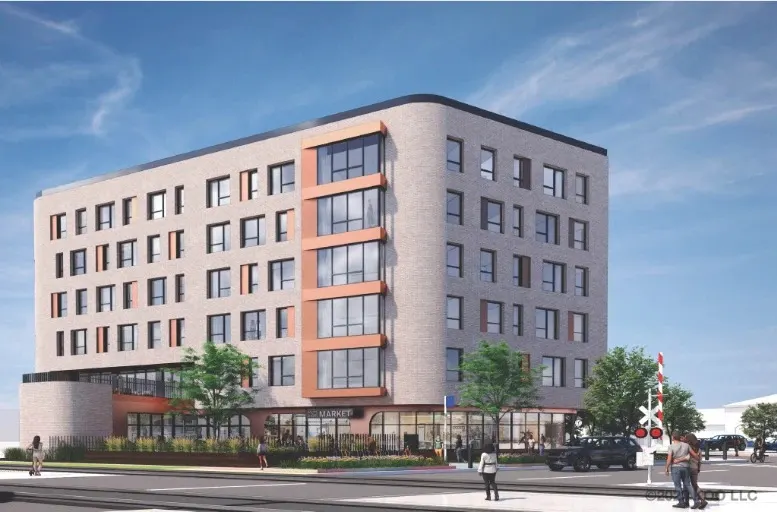
7905 S. Exchange Avenue, Chicago, Illinois 60654
We are happy to have provided our durable Magiglide closet doors throughout this project, and look forward to working with KOO and Habitat on future developments.
Until the next door opens,
Tracy