
E4: Energy & Green Building
As we head into the ending of 2025, the landscape of Low-Income Housing Tax Credit (LIHTC) allocations has taking shape—and it’s clear that this year was defined by aggressive population-driven demand, record construction needs, and intensified competition for credits in major growth markets. For developers, architects, and investors, understanding where the largest allocations fall is essential for planning pipeline strategy, site selection, and capital stacking.
This year, California, Texas, Florida, and New York once again emerge as the top four states in total LIHTC funding—each for very different reasons tied to policy, population pressures, and housing supply gaps.
As we close out the year, multifamily developers are facing a unique opportunity: massive federal tax incentives for energy-efficient and sustainable construction—many of which were expanded under the Inflation Reduction Act (IRA). These programs can dramatically reduce your cost basis, improve project feasibility, and strengthen investor appetite.
Whether you’re planning new construction, repositioning an aging asset, or integrating renewables into an existing property, these incentives deserve a top spot on your December action list.
Below is a concise breakdown of the most relevant programs for multifamily housing developers—and what you should be doing before year-end.
🔋 45L New Energy Efficient Home Credit
The 45L credit is one of the biggest wins for multifamily developers—especially those building to ENERGY STAR or Zero Energy Ready standards.
What it covers: Credits for each new or substantially reconstructed dwelling unit that meets high-performance building benchmarks.
Credit amounts:
$500–$1,000 per unit (standard multifamily ENERGY STAR certification)
Up to $5,000 per unit (Zero Energy Ready Home + prevailing wage/apprenticeship compliance)
Best for:
Ground-up construction
Garden-style and mid-rise projects
Developers looking to offset the added cost of electrification or high-performance envelopes
Why it matters now: Finalizing your energy-modeling strategy and wage compliance planning before year-end ensures your 2025 projects can maximize the credit.
💡 179D Energy Efficient Commercial Buildings Deduction
Often overlooked, 179D is a powerful deduction for developers constructing multifamily buildings taller than three stories.
What it covers: Deductions for installing qualifying high-efficiency:
Building envelope materials
HVAC systems
Lighting systems
Hot water systems
Deduction potential:
Base deduction: roughly $0.50–$1.00 per square foot
Enhanced deduction (with prevailing wage + apprenticeship): up to $5.00+ per sq ft depending on achievable energy reduction
Best for:
High-rise projects
Substantial renovations
Developers working with EPCs, MEP engineers, or design-build teams comfortable modeling 25%+ energy savings
Why it matters now: Projects that are already in design can still qualify if systems are chosen strategically. End-of-year design reviews can unlock six-figure deductions.
☀️ 48 Investment Tax Credit (ITC) – Renewable Energy Systems
If you’re considering solar, battery storage, geothermal, or other renewable technologies, the ITC can meaningfully reduce upfront cost.
What it covers: A percentage credit on eligible renewable-energy project costs.
Credit amounts:
Base 30% credit for most renewable systems
Bonus add-ons (10–20% each) for:
Best for:
Solar on rooftops, carports, or parking structures
Geothermal systems in new developments
Battery storage paired with renewable systems
Affordable housing projects aiming for stacked incentives (LIHTC + ITC)
Why it matters now: Allocations for certain low-income bonuses are competitive and require proactive planning. Year-end is a key time to align engineering scopes with eligibility requirements.
⚡ 30C Alternative Fuel Vehicle Refueling Property Credit
With EV adoption accelerating nationwide, multifamily communities are under pressure to provide charging capacity.
What it covers: Credits for installing EV charging stations or alternative-fuel infrastructure.
Credit amounts:
Up to 30% of installation costs
Higher caps available in qualifying low-income or non-urban census tracts
Best for:
Stabilized communities adding charging amenities
Lease-up properties aiming to attract premium tenants
Developers looking for cost recovery on 2025 EV infrastructure mandates
Why it matters now: Location-based eligibility can be checked quickly—and can materially improve project underwriting if chargers are planned for 2025 construction.
🧩 The Incentive Stack: Why These Credits Matter Together
The IRA removed many of the restrictions that previously prevented developers from combining green-building credits with other programs. As a result:
✔ 45L can stack with LIHTC
✔ 179D can stack with 4% and 9% credits
✔ The 48 ITC can apply to solar/storage on LIHTC properties
✔ EV charger credits can stack with other renewable incentives
Outcome: You can lower both tax liability and project capital cost, improve DSCR, and enhance investor yields—all while delivering a higher-performance asset.
📌 Year-End Checklist for Developers
Before closing the year, consider reviewing:
1. Energy modeling plans
Ensure your energy consultant is modeling both 45L and 179D pathways.
2. Wage & apprenticeship compliance
Higher incentive tiers require structured labor planning.
3. Renewable-energy feasibility
Solar and battery storage may produce both upfront credits and operational savings.
4. EV readiness
Conduit, transformer sizing, and panel capacity are cheapest to plan during design.
5. Eligibility by location
Some bonuses depend on census-tract qualification or community-type designations.
6. Documentation strategy
These credits require meticulous tracking—start assembling your compliance folders early.
✅ Multifamily Developer Checklist: Which Energy & Green-Building Tax Credits Apply to Your Project?
A quick-scan tool for 45L, 179D, 48 ITC, and 30C credits
STEP 1 — Identify Project Type
Is your project:
☐ New construction
☐ Substantial rehabilitation
☐ Retrofit/renovation
☐ Addition to an existing building
Why it matters: • 45L applies to new construction + substantial reconstructions • 179D applies to new construction and significant renovations • 48 ITC and 30C can apply to new or existing buildings
STEP 2 — Confirm Building Height & Use
How many stories?
☐ 1–3 stories
☐ 4+ stories
Why it matters: • 45L applies to any residential units • 179D applies only to buildings 4 stories or higher (treated as “commercial”)
Will there be commercial space?
☐ Yes
☐ No
Why it matters: • Mixed-use buildings can sometimes qualify for both 179D + 45L in different portions
STEP 3 — Check Your Energy-Performance Strategy
Will the building pursue any of the following?
☐ ENERGY STAR Multifamily New Construction
☐ Zero Energy Ready Home (ZERH)
☐ Modeled energy savings of 25% or more
☐ High-efficiency HVAC
☐ High-performance building envelope
☐ Efficient lighting systems
☐ Heat pump systems
Why it matters: • 45L requires ENERGY STAR or ZERH • 179D requires at least a 25% modeled energy reduction vs. ASHRAE standard
STEP 4 — Determine If Renewable Energy Will Be Installed
Are any of these in your scope?
☐ Roof-mounted solar
☐ Solar carports
☐ Battery storage
☐ Geothermal systems
☐ Microgrid or campus-style energy
Why it matters: • These qualify for the 48 Investment Tax Credit (ITC) • Bonus credits possible (domestic content, low-income, energy community)
STEP 5 — Evaluate EV Charging Infrastructure
Is your project planning:
☐ Level 2 EV chargers
☐ DC fast chargers
☐ Conduit only (rough-in for future charging)
Is the property located in a qualifying census tract?
☐ Low-income community
☐ Non-urban area
☐ Brownfield site
Why it matters: • 30C credit offers up to 30% of costs for EV chargers • BUT the location must fall in IRS-qualified census tracts
STEP 6 — Confirm Wage & Apprenticeship Plans
Will the project meet federal?
☐ Prevailing wage requirements
☐ Apprenticeship requirements
Why it matters: • Higher credit tiers for 45L, 179D, 48 ITC, and 30C require these labor standards • Missing this can reduce credits by 80–90%
STEP 7 — Check Eligibility vs. Base & Bonus Tiers
Does your project qualify for bonus add-ons?
☐ Located in an energy community
☐ Located in a low-income census tract (for ITC)
☐ Domestic content for renewable components
☐ Part of low-income housing (LIHTC may allow special ITC bonuses)
☐ On a brownfield redevelopment site
Why it matters: • ITC bonuses can stack, often pushing credits above 40%–50% of system cost
STEP 8 — Documentation Readiness
Do you have:
☐ Energy modeling consultant selected
☐ HERS rater or verifier selected (for 45L)
☐ MEP engineer modeling 179D pathways
☐ Prevailing wage/apprenticeship compliance system
☐ Solar engineering stamped design (if using ITC)
☐ Census-tract eligibility documentation (for 30C and ITC bonuses)
☐ Tracking system for invoices, certifications, and labor audits
Why it matters: • These credits require audit-ready documentation • Setting up now avoids re-work during cost certification
🎯 Quick Outcome Summary: What You Qualify For
After checking the boxes above, you should be able to determine:
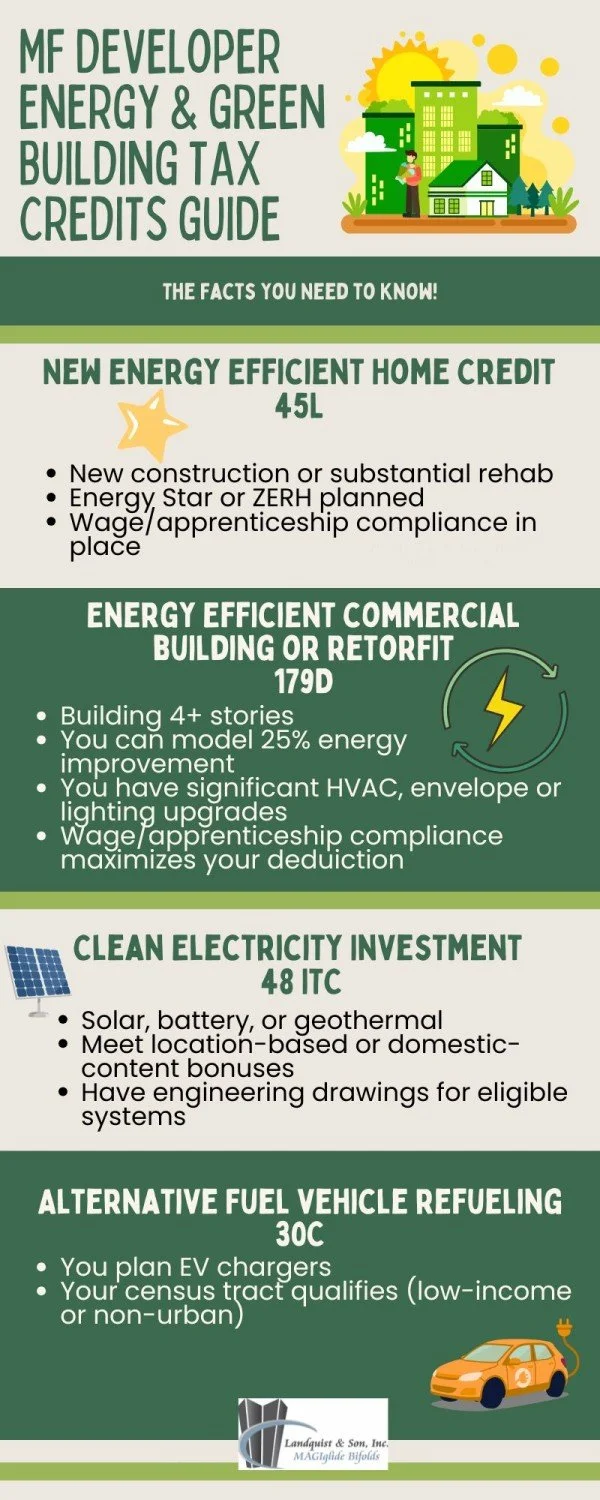
You likely qualify for 45L if:
✓ New construction or substantial rehab ✓ ENERGY STAR or ZERH planned ✓ Wage/apprenticeship compliance in place (for max credit)
You likely qualify for 179D if:
✓ Building is 4+ stories ✓ You can model 25%+ energy improvement ✓ You have significant HVAC, envelope, or lighting upgrades ✓ Wage/apprenticeship compliance maximizes your deduction per sq ft
You likely qualify for 48 ITC if:
✓ Solar, battery, or geothermal is in your scope ✓ You meet location-based or domestic-content bonuses ✓ You have engineering drawings for eligible systems
You likely qualify for 30C if:
✓ You plan EV chargers ✓ Your census tract qualifies (low-income OR non-urban)